Persecution
The Best Werewolf Short Stories 1800-1849Persecution is a sustained condition of exclusion, suspicion, and institutional violence that repeatedly converts reputation into fate. Across the book, inherited superstition and social hierarchy make the accused appear guilty before evidence is gathered, while the persecuted are forced into silence, flight, self-isolation, or resistance. The condition is therefore both social and supernatural: it may begin with legends of the Werewolf, yet its most destructive force comes from neighbors, churches, aristocratic families, courts, and rulers who decide which bodies and identities may belong.
Origins in Superstition and Inherited Stigma
The book places Persecution within the long cultural history of the Werewolf. Legends that began in superstition were transformed into folklore, legend, poetry, and eventually literature; the nineteenth century marked the period when the monster moved decisively from poetry into the short story. Earlier accounts already defined the werewolf as a human being associated with sorcery, the devil, an enchanted girdle, and violent attacks on human creatures. Such traditions supplied a vocabulary through which communities could mark unfamiliar people as naturally evil rather than judge them by their conduct.
That logic is especially severe in the history of Hugues Wulfric’s family. In the Weald of Kent, between Ashford and Canterbury, the Norman family lived in a secluded forest dwelling and worked ostensibly as wood-cutters. Their isolation was interpreted not as the result of poverty or hostility from others, but as proof that they belonged to an accursed race of wer-wolves. The supposed lycanthropic stain was believed to pass from father to son through several generations. A family name thus became a hereditary sentence: the label preceded every individual and made ordinary explanations of their circumstances irrelevant.
Rumor enlarged the stigma by attaching every local misfortune to the Hugues Wulfrics. Fires, collapsed barns, ruined crops, diseased cattle, illness, and premature childbirth were all attributed to their intervention. Stories told beside the hearth, in daylight while cattle were driven to pasture, and on Sundays outside Ashford church converted coincidence into communal certainty. The churchyard and the Wolf’s Cross became legendary sites of their nocturnal crimes because wolves had sometimes disinterred corpses during severe winters and a beggar had once fractured his skull against the cross. Accidents were absorbed into the existing story, demonstrating how Persecution sustains itself by making every contrary fact serve the accusation.
Social and Religious Exclusion
The Wulfrics did not merely suffer hostile speech; the community organized daily life to keep them outside it. They were refused employment on the domains of surrounding proprietors, denied friendship by serfs and freedmen, and treated almost as people outside the protection of ordinary society. They avoided the highways, would not enter Ashford openly by day, never appeared at Canterbury market, and took no part in pilgrimages, sports, harvest work, or communal celebrations. The priest prohibited them from communion, while the men of the alehouse excluded them from social fellowship. Persecution therefore operated through both formal and informal institutions, making religious and economic participation conditional on an identity the family could not escape.
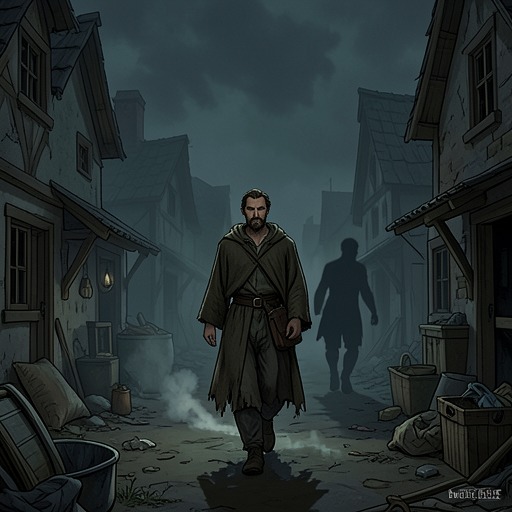
The family’s hut expresses the material consequence of this exclusion. Built of chalk and clay, covered with torn straw thatch, and marked by a rotten door through which the wind entered freely, it stood apart from neighboring homes. At twilight, when marsh vapors mingled with darkness and will-o’-the-wisps appeared, nearby serfs avoided approaching it. Their fear made the dwelling more isolated, and the isolation in turn seemed to confirm their fear. Even when the family took no action, the surrounding population’s interpretation of their existence produced the conditions associated with the monster: solitude, poverty, and distance from human society.
The consequences became fatal after Hugues Wulfric’s parents and two younger sisters died. He buried his parents himself, wrapping their bodies in strips of hemp because no one offered assistance, and later watched his sisters descend into the grave within a fortnight. When winter interrupted work in the woods and fields, he sought employment at neighboring farms to thresh grain, cut wood, or drive the plough. No one would hire him because of the supposed fatality attached to the name Wulfric. Farmers answered with taunts and threats, set dogs upon him, and even withheld the alms ordinarily given to professional beggars. The persecution drove him toward starvation and suicide, leaving love as the only force that persuaded him to remain alive.
From Suspicion to Proof and Punishment
The same mechanism appears in the accusation against Michael Thilouze and Francoise Thilouze. Manon Thierry, inflamed by jealousy over Victor de Vardes’s attention to Francoise, did not truly believe that Michael and his daughter had bewitched him. Nevertheless, she nodded in a way that suggested secret knowledge, and Pierre Bloui carried the insinuation to the huntsmen. The rumor soon became a shared conviction that the physician and his daughter were not entirely human or respectable. Here Persecution begins with a deliberately misleading gesture rather than a discovered crime.
The accusation gained force because aristocratic interests required it. Victor’s family wanted the estates of Montmorenci and De Vardes united, and they could not tolerate the poor physician’s daughter displacing Clemence de Montmorenci as Victor’s intended bride. Their strongest appeals failed to change Victor’s devotion, so pride of blood, contempt for the rights of ordinary people, ignorance, and superstition supplied a convenient alternative. Jacques Renard’s suggestion that Michael and Francoise practiced witchcraft was seized upon because it transformed an unequal love affair into a public emergency. Whether Jacques believed his own allegation mattered less than its usefulness: the charge protected hierarchy by presenting social disobedience as supernatural corruption.
Pierre’s discovery of a wolf’s foot made the rumor appear incontrovertible. Francoise had escaped a trap at the cost of her left hand, and the severed limb retained the wolf’s form after she resumed her human shape. To Pierre, this was proof of sorcery; to the authorities, it became evidence that could be displayed in court. Within hours, the commissaire du quartier and a mob from Loques carried Michael and Francoise away on a charge of witchcraft. Their trial was controlled by powerful enemies, and the physician and his daughter were quickly found guilty and condemned to die at the stake despite their pleas of innocence.
The sentence shows how Persecution converts an object into an entire legal narrative. The court declared that Francoise had bewitched Victor, had transformed herself into a wolf on several occasions, and had lost her hand while caught in a trap. The missing hand and the wolf’s missing foot were treated as mutually confirming facts, although their meaning depended entirely on the accusation already accepted. The judgment did not investigate whether the evidence could bear another interpretation; it used the physical remains to stabilize a story that served the interests of those who had demanded Victor’s separation from Francoise.
Public Violence and Reversal
The execution at Loques made persecution a collective spectacle. Scaffolding surrounded the marketplace, with tapestry and flowers decorating the section reserved for the gentry. The families of Montmorenci and De Vardes attended, while Clemence stayed away because she could not bear to watch the death of her rival, even though she still accepted the justice of the sentence. Michael and Francoise were marched around the square so the assembled spectators could see them, then placed before the faggots while the bishop celebrated mass and preached on the enormity of their alleged crime.
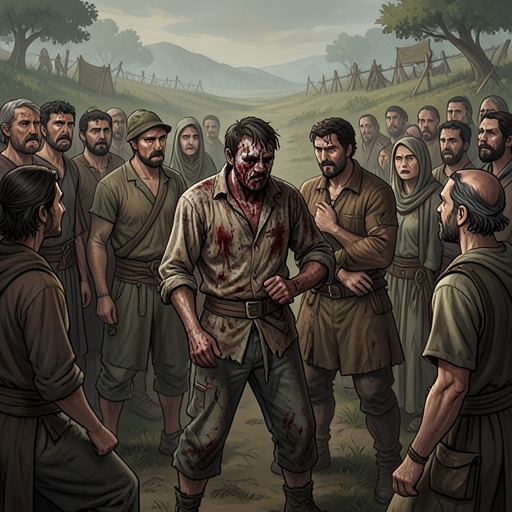
Michael’s response exposed the human cost hidden by the judicial language. Kneeling before the crowd, he begged that Francoise be spared and asked to die alone. Some spectators were moved, but a voice from the nobles’ section ordered the executioner to continue. The crowd’s sympathy was therefore weaker than aristocratic authority. When Manon arrived disheveled, bloodstained, and dragging a dead wolf, however, the public mood changed. She could not speak, but pointed to the animal and pleaded for mercy. Her suffering and evidence made the people turn from spectators into petitioners, crying for pardon; the nobility still attempted to silence them and proceed with the burning.
The reversal came through royal power rather than through the ordinary court. Victor de Vardes arrived on a foam-covered horse carrying the king’s order for arrest of execution. Pierre Bloui had successfully carried Victor’s appeal to Henry IV, who issued a mandate postponing the punishment for further investigation. Once the king’s favor became known, the supposed harmlessness of Michael and Francoise was broadly acknowledged. The proof that had condemned them—the foot without the wolf—was reinterpreted through the wolf without the foot, revealing that guilt and innocence had depended less on the object than on which authority controlled its meaning.
Resistance, Mobility, and Narrative Significance
Persecution also shapes the family history of Krantz. His father was a wealthy and educated serf in Transylvania who had risen to become his lord’s steward, yet birth fixed his legal status permanently: whoever was born a serf remained a serf. His social subordination formed the background to his wife’s affair with the nobleman who owned the land. When the father discovered them together, he murdered both, knowing that his position as a serf meant that even provocation would not be accepted as a justification. He fled with his children in winter, pursued by authorities and unable to remain anywhere in his native country, until he buried himself in the Hartz Mountains.
The supernatural judgment that followed did not erase the social structure that had produced the violence. A spirit declared that the father had committed double murder and would pay the penalty attached to his marriage oath: two children were already gone, the third would follow, and the punishment was that he must live. He then left the mountains with Krantz, reached Holland, died raving mad in Amsterdam, and left Krantz to an asylum before the young man was sent to sea. The sequence links Persecution to inherited guilt, forced migration, institutional confinement, and the fear that a father’s crime and oath will determine a son’s future.
Across these episodes, Persecution is not a single act but a chain: naming produces suspicion; suspicion produces avoidance; avoidance produces poverty and isolation; rumor then supplies apparent confirmation; finally, powerful institutions turn the label into punishment. The Werewolf tradition gives the chain its most visible shape, but the book repeatedly shows that persecution can be generated by class, religion, law, ancestry, or sexual jealousy. Its deepest significance lies in that convergence. A monster may be imagined in folklore, yet the community’s refusal to see a person outside the label can create consequences as real as starvation, exile, imprisonment, execution, or inherited fear.